



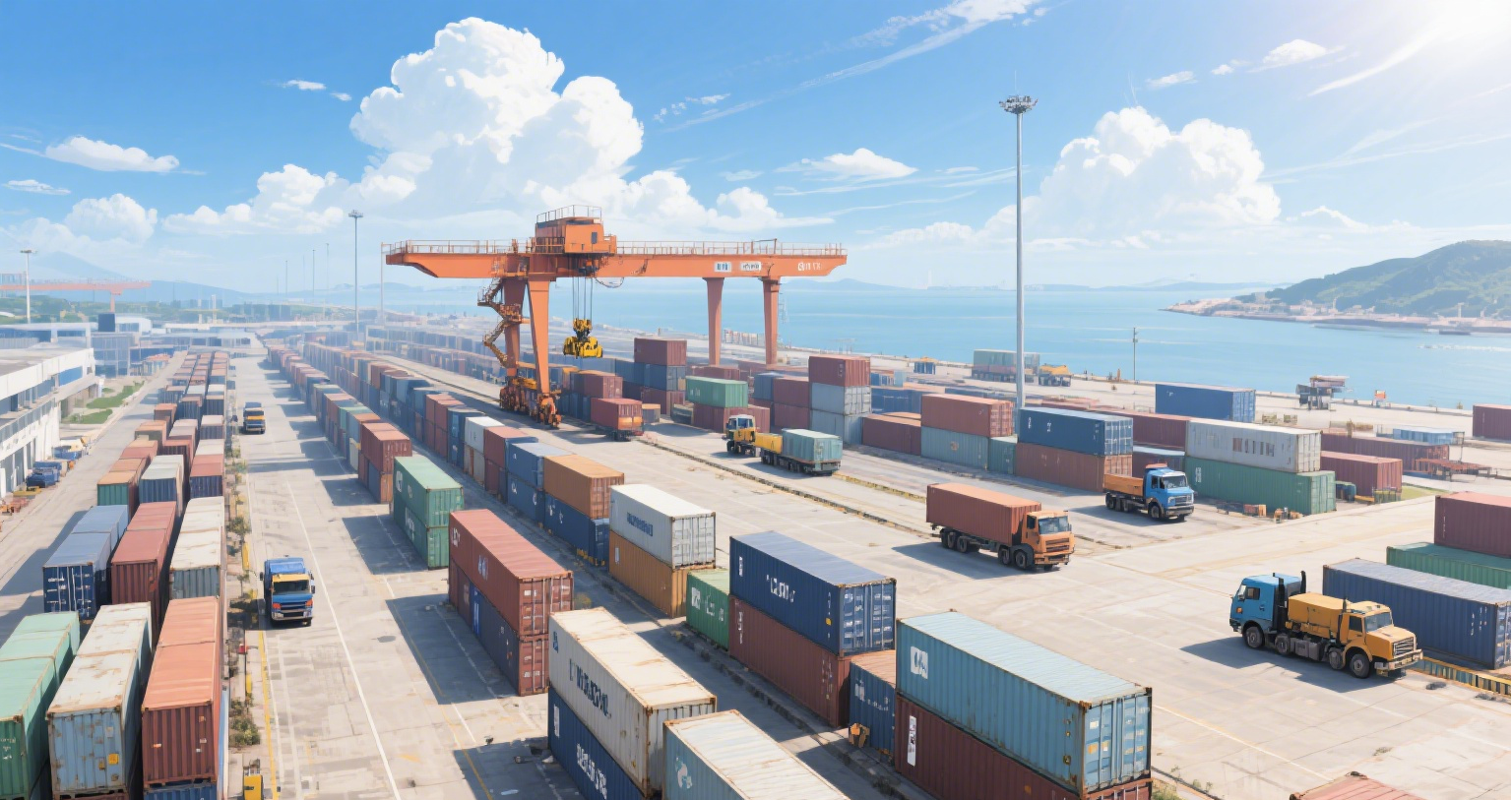

The picture shows the busy container terminal at Lianyungang Port in Jiangsu Province. Wang Chun Photo (People’s Vision)
A few days ago, the World Trade Organization released the global trade in goods data for 2023. The data show that the total value of China’s imports and exports in 2023 amounted to 5.94 trillion U.S. dollars, maintaining the status of the largest country in global trade in goods for seven consecutive years; among them, the international market shares of exports and imports were 14.2% and 10.6%, respectively, remaining the first and the second in the world for 15 consecutive years. Against the backdrop of a difficult recovery of the world economy, the Chinese economy has demonstrated strong developmental resilience, providing a driving force for global trade growth.
Buyers of Chinese goods have spread all over the world
According to global trade in goods data for 2023 released by the World Trade Organization, global exports totaled $23.8 trillion in 2023, a decline of 4.6%, following two consecutive years of growth in 2021 (up 26.4%) and 2022 (up 11.6%), and still up 25.9% from the pre-epidemic year of 2019.
Specifically for China, in 2023, the total value of China’s imports and exports will be 5.94 trillion dollars, which is 0.75 trillion dollars more than the United States, which is in second place. Among them, China’s international market share of exports is 14.2%, the same as in 2022, maintaining the first place in the world for 15 consecutive years; the international market share of imports is 10.6%, maintaining the second place in the world for 15 consecutive years.
In this regard, Liang Ming, director of the Institute of Foreign Trade of the Institute of International Trade and Economic Cooperation of the Ministry of Commerce, believes that in 2023, against the backdrop of a complex and severe external environment, a sharp slowdown in international market demand and the outbreak of local conflicts, the international market share of China’s exports has remained fundamentally stable, demonstrating China’s foreign trade’s strong resilience and competitiveness.
“In 2023, China’s foreign trade presents the following characteristics: first, the overall stability of foreign trade operation, the four quarters of the good trend is obvious; second, the main body of the business is full of vitality, and the main role of private enterprises has been strengthened; third, the diversification of trade partners, the import and export of ‘One Belt, One Road’ countries accounted for a higher proportion; fourth, the competitive product Fourthly, the competitive advantage of products is solid, and the export kinetic energy is rich and active; fifthly, the domestic demand continues to recover, and the imports of bulk and livelihood commodities are expanding in an orderly manner; sixthly, the opening up of a high level is steadily advancing, and the development of new platforms and new forms of business has gained momentum. To summarize, the performance of China’s foreign trade can be summed up in four words, namely, ‘stable quantity and excellent quality’.” Gao Lingyun, a researcher at the Institute of World Economics and Politics of the Chinese Academy of Social Sciences, analyzed in an interview with this reporter.
Since 2024, China’s foreign trade imports and exports have achieved a good start.On April 12, China’s General Administration of Customs released the first quarterly report of 2024 foreign trade. Data show that in the first quarter of this year, China’s trade in goods import and export value of 10.17 trillion yuan, an increase of 5%. From the scale, the history of the same period for the first time exceeded 10 trillion yuan; from the point of view of the growth rate, a record high in six quarters.
Wang Lingjun, deputy director of the General Administration of Customs, said at a press conference recently that, at present, global trade is showing signs of stabilization and improvement. China Customs Trade Prosperity Survey results show that the proportion of enterprises reflecting the increase in exports and import orders in March was significantly higher than last month. China’s imports and exports are expected to continue to improve in the second quarter, and basically remain in the growth channel in the first half of the year.
According to an article in The New York Times, buyers of Chinese goods have spread all over the world from steel, automobiles, solar cells to electronic products, especially in Latin America and Africa, which are very interested in Chinese goods. The Associated Press believes that in the overall global economic downturn, China’s imports and exports have seen significant growth, reflecting a welcome phenomenon that the global market is recovering.
The “new three kinds” release the new dynamic energy of foreign trade
“China’s export international market share of 14.2%, for seven consecutive years to maintain the status of trade in goods as the largest country.” The person in charge of the Foreign Trade Department of the Ministry of Commerce recently pointed out that the stable import and export market share fully demonstrates that, relying on the production and supply chain supporting the integration of advantages and sustained innovation, China’s various types of high-quality products are welcomed by the international market. Relying on the advantage of large-scale market, China’s imports also provide a strong impetus for the economic development of all countries.
Gao Lingyun analyzed that China’s stable growth in foreign trade support factors from various aspects: “From the export point of view, first of all, China has a complete industrial system, is the world’s only country with the United Nations Industrial Classification of all industrial categories, China’s manufacturing industry has a strong production capacity; Secondly, China’s foreign trade business entities continue to enhance the vitality of the new space for development Secondly, the vitality of China’s foreign trade business entities continues to increase, constantly opening up new space for development, especially the outstanding performance of private enterprises, and the growth rate of foreign trade is significantly faster than the overall level; thirdly, the dividends of stabilizing foreign trade policies continue to be released, and the Chinese governments at all levels have come up with some hard and practical measures to promote the stabilization of the scale and optimization of the structure of foreign trade, to promote the development of the private economy, and to accelerate the integration of the domestic and foreign trade. In terms of imports, first, China has the largest middle-income group and is the world’s most promising large market; second, China has further enhanced its mega-market effect and consumption potential by organizing the Expo, lowering tariffs, and other actions.2023, China imported more than 5 trillion yuan of staple commodities, nearly 3 trillion yuan of electronic components, and nearly 2 trillion yuan of consumer goods, which provide enterprises from all countries with broad market space and cooperation opportunities.”
It is worth noting that in recent years, thanks to scientific and technological innovation, scenario innovation, and iterative upgrading of digital technology facilities, China’s foreign trade, while maintaining the stability of the total volume, has been continuously upgrading and upgrading, and the new kinetic energy continues to be stimulated. According to statistics from the General Administration of Customs, in 2023, China exported 13.92 trillion yuan of electromechanical products, an increase of 2.9%, accounting for 58.6% of the total value of exports. Among them, electric passenger cars, lithium-ion batteries and solar batteries and other “new three kinds” of products exported a total of 1.06 trillion yuan, for the first time exceeded the trillion yuan mark.
Zhang Jianping, deputy director of the Academic Committee of the Institute of International Trade and Economic Cooperation of the Ministry of Commerce, believes that electric people-moving vehicles, lithium-ion batteries and solar cells and other “new three” shaped China’s foreign trade and new growth points, enhance the competitiveness of China’s foreign trade, but also in line with the current global pursuit of low-carbon green development trend and trend.
Gao Lingyun pointed out that China’s foreign trade highlights appear frequently, to the high quality development of global trade has brought many positive impacts: “First, China withstand external pressure, overcome internal difficulties, the import and export of goods trade to achieve the goal of promoting stability and improving quality, which can help to pull the growth of global trade, and to maintain the stability of the global industrial chain supply chain; second, China’s foreign trade continues to improve the quality of upgrading, with high technology, High-tech, high value-added, green and low-carbon features of the new dynamics of foreign trade to further promote China’s foreign trade and stable growth, helping to promote global green development; Third, China adheres to multilateralism, constantly expanding opening up, and efforts to safeguard the interests of the vast number of developing countries and emerging markets in the global trading system.”
Actively maintaining the stability of the global industrial chain supply chain
The World Trade Organization released a report concluding that in 2024, global inflationary pressures are expected to weaken further and real incomes will grow again, thus boosting consumption. In addition, the new export orders index indicates that the recovery trend of goods trade in 2024 has been very clear. The report predicts that global trade in goods may grow by 2.6% in 2024, after declining by 1.2% in 2023, and that the recovery momentum of 2024 may continue in 2025, with a growth of 3.3%. However, the World Trade Organization cautioned that uncertainties brought about by geopolitical conflicts and protectionism are still rising significantly, and global trade is still likely to decline.
The Yellow Book on the World Economy: Analysis and Forecast of the World Economic Situation in 2024, released by the Institute of World Economics and Politics of the Chinese Academy of Social Sciences and the Social Sciences Academic Press, argues that, based on the forecasts of international organizations, global trade will grow at a higher rate than that of 2023, although it will not rebound strongly in 2024. The World Trade Organization, the International Monetary Fund and the World Bank forecast world economic growth of 2.5%, 3.0% and 2.4% in 2024, respectively, which is lower than the annual average level of 3.8% from 2000 to 2019, the Yellow Book analysis said. In terms of cyclical or demand factors, the pulling power of the world economy on trade will remain weak in 2024, which is the main reason why it will be difficult for global trade in goods to rebound strongly in 2024.
“In 2024, the challenges facing global trade will mainly come from the following aspects: first, the increased risk of geopolitical conflicts; second, the slowdown in demand growth in major global economies; third, the rising momentum of trade protectionism, with certain countries erecting various types of trade barriers, which will interfere with the stabilization of the global industrial chain supply chain; fourth, the secondary impacts brought about by geopolitical conflicts, such as the Red Sea shipping channel is blocked, raising the cost of global trade; Fifth, the global debt risk is aggravated, increasing economic vulnerability, which in turn affects global trade.” Gao Lingyun said.
The person in charge of the Foreign Trade Department of the Ministry of Commerce recently said that in order to cope with the severe and complex external environment, the Ministry of Commerce is working with various localities and departments to study and reserve a series of pragmatic and practical policy initiatives, focusing on fostering new dynamics in foreign trade and helping foreign trade enterprises to develop markets. China will continue to promote a high level of opening up to the outside world, deepen close cooperation with trading partners, and strive to make new positive contributions to the recovery of global trade.
World Trade Organization chief economist Ralph Ossa said in a recent interview, China will become an important driver of global trade growth. China’s expansion of Europe’s “visa-free circle of friends” and the continued recovery of China’s outbound tourism are favorable factors to promote the growth of global trade in services.
“China has always been a staunch supporter and defender of economic globalization and advocates the settlement of trade disputes within a multilateral framework. At the same time, China’s door to open up is opening wider and wider. In recent years, China has continued to reduce tariffs and expand imports by organizing the Fair and other forms, so that the world can better share the opportunities of the Chinese market.” Gao Lingyun said that in the context of the rising risk of “decoupling and chain breakage”, China actively maintains the security and stability of the global industrial chain supply chain, promotes the recovery of global trade, and continuously promotes the signing and upgrading of FTAs, which will have a positive pulling effect on global trade growth.


