





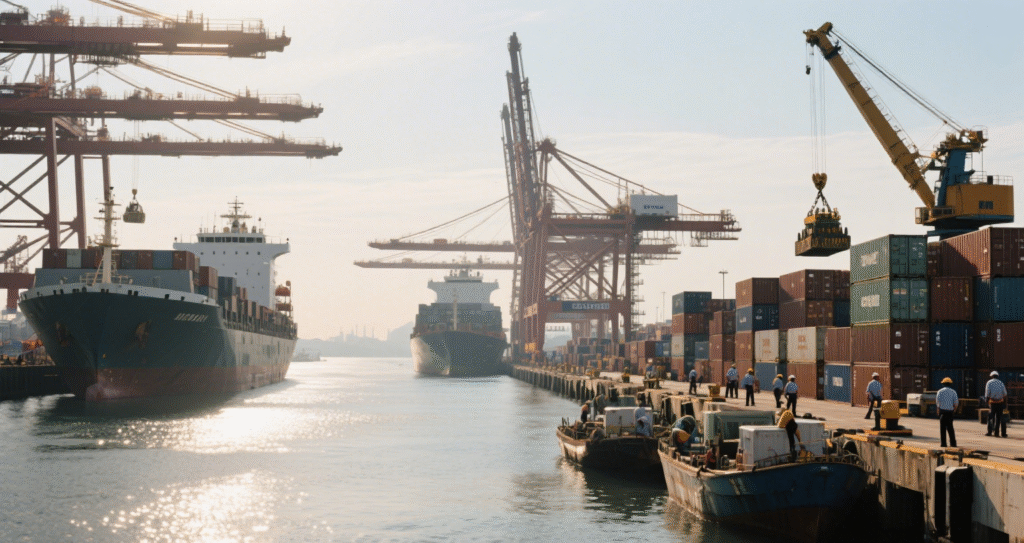
The United Nations Conference on Trade and Development (UNCTAD) recently released a report showing that global trade trends improved in the first quarter of 2024, with the value of trade in goods increasing by about 1 per cent and the value of trade in services increasing by about 1.5 per cent from a year earlier. The growth in global trade in the first quarter was “driven by positive trade dynamics in the United States and developing countries, particularly in Asia”. Expert analyses have pointed out that global trade is now coming out of the doldrums, and developing countries are expected to contribute to a more robust growth momentum, with “dynamic Asia” adding bright colors to the resumption of growth in global trade.
Recovery is evident
The World Trade Organization (WTO) recently released its latest trade statistics, which show that global merchandise trade turned up in the first quarter of 2024, after being flat for the whole of 2023: merchandise trade, as measured by the average value of exports and imports, grew by 1.0% in the first quarter compared to the previous quarter. The value of trade also increased by 1.4 per cent in the first quarter compared with the same period in 2023.
The United Nations Conference on Trade and Development (UNCTAD) report shows that in the first quarter of this year, import and export trade in most regions of the world showed positive growth in line with the global trend, with strong trade growth in East Asia and the Americas. China’s trade exports grew by 9 percent from a year earlier, leading the world’s major economies, while India’s exports grew by 7 percent from a year earlier during the same period. The strong trade performance of developing countries was matched by a 2% increase in South-South trade, mainly in East Asia. Among developed countries, the United States of America performed better, with exports growing by 3 per cent from a year earlier, but Europe did not perform as well, with imports and exports continuing to fall simultaneously.
In terms of sectoral breakdowns, trade growth varied significantly across sectors globally. UNCTAD reports stronger growth in products related to green energy and artificial intelligence. Compared to the first quarter of 2023, trade in high-performance servers increased by 25%, and trade in other computers and storage devices increased by 8%. Trade in electric vehicles also grew significantly, by about 25%. Demand for electric vehicles, solar panels, batteries and high-end semiconductors is expected to grow further in many countries.
“Asian regional trade growth performance is brighter, especially in East Asia, Southeast Asia, the manufacturing industry recovery trend is obvious.” China Center for International Economic Exchanges U.S. and Europe, deputy director of the research department, researcher ZhangMoNan said in an interview with this reporter, on the one hand, since this year, South Korea’s exports have grown significantly, reflecting the vitality of global trade to rise the important trend changes. South Korea as a global trade “canary”, its export data on the observation of global trade changes have a certain “wind vane” meaning. On the other hand, as the core link of the Asian industrial chain and supply chain, China’s manufacturing industry has been upgraded, and the export of new energy vehicles, lithium batteries, photovoltaic products and other “new three sorts” has made a greater contribution to the growth of global merchandise trade. In addition, China and ASEAN are each other’s largest trading partners, China and ASEAN countries to deepen industrial chain cooperation, ASEAN countries to increase import and export to play a more obvious role in pulling.
Improvement of the general environment
The United Nations Conference on Trade and Development (UNCTAD) reported that, overall, the moderation of global inflation and improved growth forecasts suggest that the macroeconomic downward trend that has been under way is being reversed. In addition, rising demand for products related to the energy transition and artificial intelligence will boost trade growth in 2024.
“Since this year, the resumption of global trade growth is related to changes in the global economic environment and geopolitical context.” Zhang Mornan pointed out that in the previous two years, global trade growth slowed down due to geopolitical conflicts, a sharp rise in global energy prices, rising commodity prices, disruptions in the global supply chain, and widespread interest rate hikes in developed countries to curb inflation. Since the beginning of this year, the impact of geopolitical conflicts on the economy has relatively weakened, global energy prices and commodity prices have come down, inflation in developed countries has eased, and the overall environment for global trade has gradually improved.
“China’s continuous expansion of opening up to the outside world, the Asian region to release the vitality of trade to play an important role in promoting.” Xie Laihui, director of the “Belt and Road” Research Office of the Institute of Asia-Pacific and Global Strategy of the Chinese Academy of Social Sciences (CASS), analyzed in an interview with this reporter that, on the one hand, the scale of merchandise trade between China and its Asian neighbors, such as Japan, South Korea, and Vietnam, has seen a more pronounced growth since the beginning of this year. China’s “new three kinds” of products to Asian countries, the supply of rapid growth. On the other hand, thanks to China in the first half of this year to take the unilateral visa-free policy for citizens of many countries and 72/144 hours of transit visa-free policy, the rapid increase in the number of foreign personnel to China and China’s rapid increase in the number of people out of the country, but also to promote the growth of Sino-foreign trade in services.
“It is worth mentioning that the Regional Comprehensive Economic Partnership Agreement (RCEP) promotes regional economic integration, trade facilitation, effectively reduces trade costs among member countries, enhances trade efficiency, and plays a positive role in promoting trade growth in the Asian region.” Zhang Malnan said.
Openness must be maintained
“Global trade is not at its best right now.” WTO Director General Ngozi Okonjo-Iweala recently said, “We are seeing increased protectionism and the undermining of some of the WTO’s rules, some of which are leading to the fragmentation of global trade. Global trade should be one of the lifebloods of countries to sustain recovery and underpin economic growth, so we are concerned about this.”
The BBC website recently reported that the European Union recently announced plans to impose temporary tariffs of up to 37.6% on imports of Chinese electric cars. This comes after the U.S. imposed a 100 percent tariff on Chinese electric cars in May and raised import tariffs on a range of Chinese products such as electric car batteries and the minerals they contain, batteries needed to make solar panels, and computer chips (wafers). The U.S. government has previously poured billions of dollars into green technology in the country through the Inflation Reduction Act.
“At present, a small number of developed countries are pursuing trade protectionist policies, erecting trade barriers against foreign enterprises and providing massive subsidies to domestic enterprises, and transforming more and more international trade into domestic production and domestic consumption, which will not only increase the trade costs of the relevant enterprises, but also destroy the original structure of the global supply chain, industrial chain and value chain, and have a negative impact on the growth of global trade and economic globalization will bring negative impacts.” Xie Laihui said.
A United Nations Conference on Trade and Development (UNCTAD) report projects that global gross domestic product (GDP) will grow by about 3 per cent in 2024, with a cautiously optimistic short-term trade outlook. Factors such as geopolitical tensions, rising transportation costs and emerging industry policies could reshape the global trade landscape. Trade restrictive measures and undue focus on domestic industries may hamper international trade growth.
Xie Laihui believes that at present, the total GDP of developing countries around the world has exceeded that of developed countries, and developing countries are united in insisting on opening up to the outside world, which is conducive to promoting the development of the global economy in the right direction. In the Asian region, RCEP continues to play a role in promoting trade facilitation and investment facilitation, strengthening the industrial chain and supply chain cooperation of Asian countries, and bringing common development opportunities for Asian countries. China is a major trading partner of more than 140 countries and regions, and has signed more than 200 cooperation documents on building the Belt and Road with more than 150 countries and more than 30 international organizations. China has great potential to promote the economic and trade fields, and has always contributed positively to the growth of global trade.
According to Zhang Maonan, China continues to promote a high level of opening up to the outside world: on the one hand, it attracts multinational enterprises to deeply integrate into China’s industrial chain and supply chain, and strengthens the closeness of China’s trade and cooperation with overseas countries; on the other hand, it promotes the deep integration of Chinese enterprises into the overseas market, and builds multinational enterprises with international influence. This “two-way” opening up will not only promote the construction of China’s modern industrial system and serve the process of Chinese-style modernization, but will also contribute to the growth of global trade and the healthy development of economic globalization.


